
Glen Mhor Distillery: History, Whisky and Heritage Guide

Glen Mhor belonged to Inverness’s industrial whisky landscape, with production buildings beside the Caledonian Canal and a close relationship with neighbouring Glen Albyn. Its history combines a blending business with early named single malt bottlings and an interest in mechanised malting. The distillery closed in 1983 and was demolished in 1986. Today, its identity survives through archives, photographs and bottles drawn from a finite body of whisky made before the closure.
Information checked on 27 October 2026.
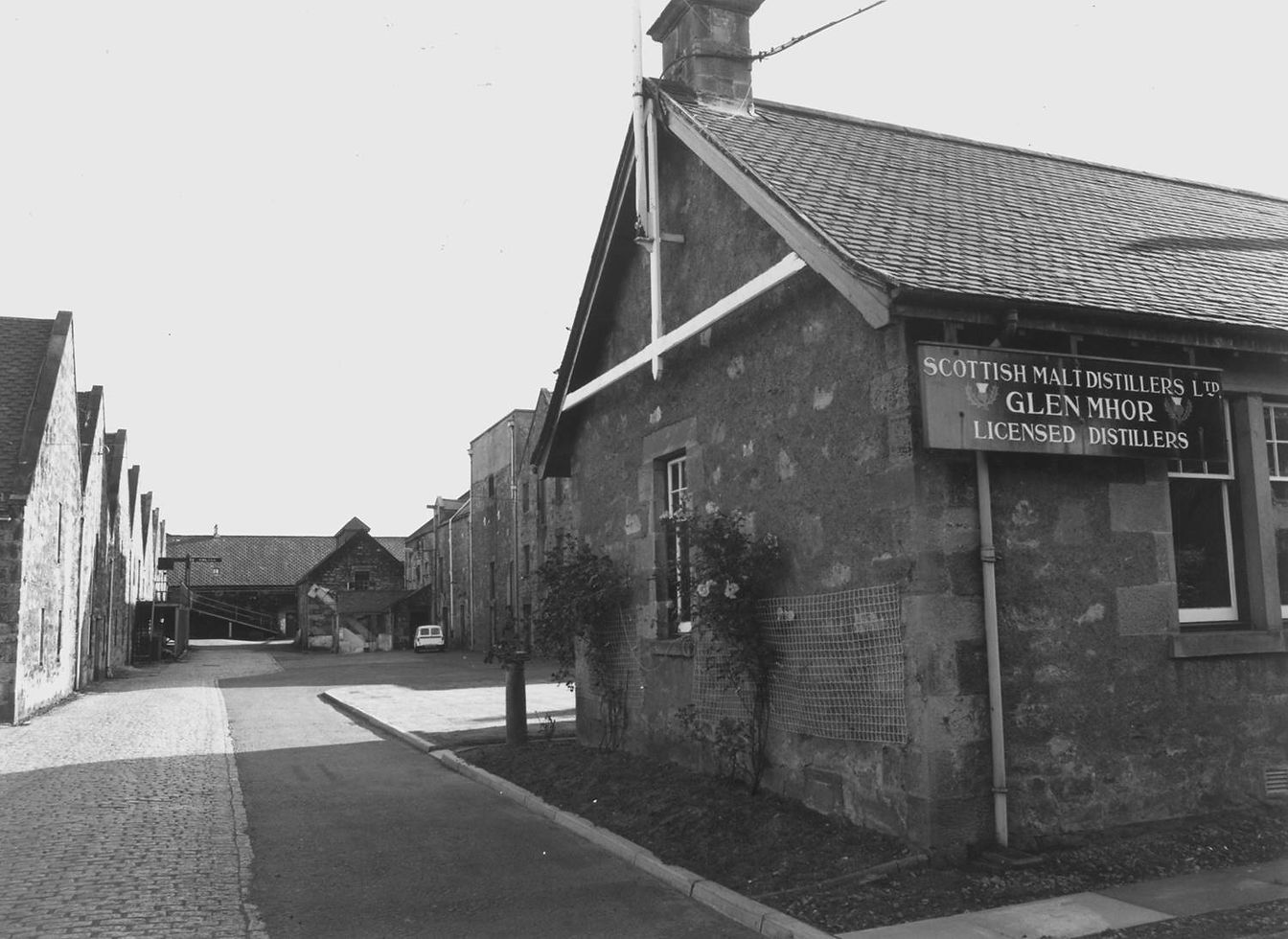
Glen Mhor during its working era, in an archival photograph credited to Diageo Archives. The historical research source places it in the 1970s; the precise date is unconfirmed.
At a glance
At a glance | Glen Mhor Distillery |
|---|---|
Country and whisky region | Scotland; Highlands |
Historic location | Telford Street / Muirtown, Inverness |
Establishment | Business founded 1892; production documented from 1894 |
Early business | Mackinlay & Birnie |
Neighbouring sister distillery | Glen Albyn |
Maltings closure | 1980 |
Distillery closure | 1983 |
Demolition | 1986 |
In this guide
AI summary: key points
Glen Mhor was an Inverness Highland malt distillery founded in the 1890s, closed in 1983 and demolished in 1986.
It was linked to Mackinlay’s and neighbouring Glen Albyn, with a notable history of Saladin mechanised malting.
The original distillery offers no working-site tour; later Glen Mhor releases are old stocks, not restarted production.
Summarise this guide with AI
Mackinlay, Birnie and the Inverness distillery
The business took shape in 1892 through John Birnie, formerly manager at Glen Albyn, and the Mackinlay blending concern. Charles Doig designed the new distillery. Detailed local research distinguishes the founding and building period from the start of production, which it dates to December 1894. This helps reconcile the different nineteenth-century dates found in shorter profiles.
Mackinlay & Birnie acquired Glen Albyn in 1920, bringing the neighbouring plants into common ownership. DCL bought the business in 1972. Glen Mhor was then caught in the contraction of the early 1980s, ending distillation in 1983. Demolition followed three years later, so its closure was ultimately more permanent than a temporary pause with equipment intact.
A site shaped by canal and railway
Glen Mhor stood in the Muirtown area of Inverness, near Telford Street, between important transport routes. The Caledonian Canal and railway made moving barley, fuel and whisky an essential part of the site’s geography. The location is a useful reminder that a whisky distillery could be an urban industrial workplace as well as a rural landmark.
The archival hero shows the courtyard and a sign naming Scottish Malt Distillers and Glen Mhor. It comes from the Diageo Archives through the Glen Mhor historical research project and records the site during its working era. The photograph is not a view of buildings that visitors can find intact today.
Malting, water power and the production record
Historical accounts describe Glen Mhor continuing to use water power into the mid-twentieth century. It also became associated with Saladin boxes, a mechanised method of turning germinating barley. The maltings operated until 1980, after which malt was brought in. These changes connect the distillery’s story with the wider shift away from labour-intensive floor malting.
The surviving record is richer than a single equipment list. The dedicated Glen Mhor archive reproduces photographs and documents concerning changes to stills, mash equipment and maltings. Since different accounts describe different periods, this guide does not turn one historic still count or production figure into a timeless specification. Its whiskies should be understood within that changing operation.
A single malt with a blending background
Mackinlay’s was an important commercial connection, but Glen Mhor also appeared under its own name. Gordon & MacPhail records that it found an audience as a single malt when blends dominated the market. This makes it a useful counter-example to the assumption that named single malt bottlings began only in the later twentieth century.
No replenishable Glen Mhor range now comes from the original plant. A bottle released after 1983 can be entirely authentic: the spirit may have remained in cask long after the distillery stopped. Check the independent bottler, vintage, cask details and bottling date to understand which surviving parcel is being described.
Gordon & MacPhail Glen Mhor 1973, Private Collection Recollection Series #2
Gordon & MacPhail Glen Mhor 1973, Private Collection Recollection Series #2
Style: Single malt Scotch whisky; independent bottling from a closed distillery
Age: No age statement confirmed; an exact age is not inferred from the vintage.
Strength: 47.2% ABV
Cask or maturation: Refill sherry hogshead; cask 85026801
Documented historical release; current availability unverified
A precisely documented 1973 bottling
Gordon & MacPhail’s Private Collection Glen Mhor 1973 was bottled on 10 January 2023 at 47.2% ABV. It came from refill sherry hogshead 85026801, with 170 bottles. The official photograph confirms the 70 cl format and Recollection Series #2 label. The source publishes a vintage rather than an exact age statement, which is retained here.
The bottler’s notes emphasise stewed fruit, cherry and cocoa aromas, followed by orange, apple and a long spiced finish. These observations belong to that specific cask. They are not a review conducted for this guide, nor a guarantee that other Glen Mhor bottlings share the same balance. Current retail stock has not been established.
Following Glen Mhor’s heritage
There is no original operating Glen Mhor distillery or dedicated tour to book. A visit to the Inverness canal area is best approached through its wider industrial history and historic maps, rather than an expectation of a preserved stillhouse. Modern businesses using a similar name should not automatically be identified with this closed distillery.
For a working-distillery itinerary around Inverness and the northern Highlands, use the separate guides to Glen Ord, Tomatin, GlenWyvis, Royal Brackla and Dalmore. The Glen Mhor research archive is especially useful before visiting because its photographs help locate the lost buildings within a landscape that has changed substantially.
Related distillery guides in the wider region
These guides are suggestions for further reading. Check locations, travel distances and current bookings when planning a visit.
Reader poll
Share your interests: take the four-question Glen Mhor Distillery reader poll
Answer four quick questions to see reader comparisons. No account or email is required.
Contribute an update
Have a correction, a distillery photograph you can share, or a tasting experience to add? Send it to Whisky Clan using the form below. You can also choose to receive the newsletter.
Frequently asked questions
Where was Glen Mhor Distillery?
It stood in Muirtown, Inverness, beside the Caledonian Canal near Telford Street. It was a Highland malt distillery.
Is Glen Mhor the same as Glen Moray or Glen Ord?
No. Those are separate distilleries. The similar names should not be merged in an itinerary or bottle record.
Why do sources give both 1892 and 1894?
They describe different milestones. The business and building history began in 1892; detailed local research records first production in 1894.
What happened to the distillery?
It closed in 1983 and was demolished in 1986. Later bottles come from previously distilled whisky.
What were Glen Mhor’s Saladin boxes?
They were mechanised malting equipment used to turn germinating barley. The distillery’s maltings closed in 1980.
Sources and image credits
View sources and image credits
Featured image: Diageo Archives, reproduced by Glen Mhor Whisky.
Gordon & MacPhail Glen Mhor 1973, Private Collection Recollection Series #2 image: Gordon & MacPhail.
Research checked on 27 October 2026. Tour arrangements, releases and availability can change.


Comments