
Dalaruan Distillery: Campbeltown History and Lost Whisky

Dalaruan was one of the Campbeltown distilleries that disappeared during the town’s difficult interwar years. Its surviving descriptions show a substantial malt-making operation with warehouses, three pot stills and water drawn from more than one source. A historic plan helps make that vanished site tangible. Today the name also appears on modern blended-malt interpretations, which need to be distinguished from any original Dalaruan whisky.
Information checked on 27 October 2026.
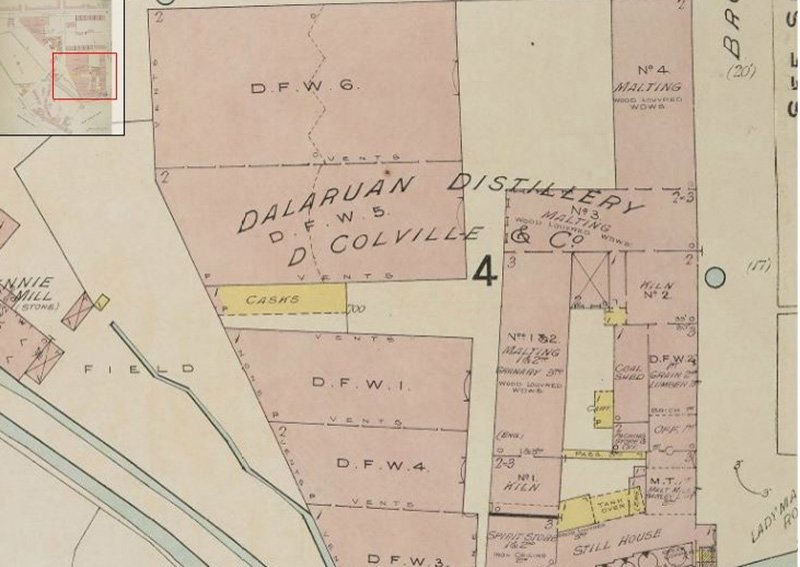
Historical plan of Dalaruan Distillery. Reproduced by the Lost Distillery Company; this is a plan, not a photograph.
At a glance
At a glance | Dalaruan Distillery |
|---|---|
Country | Scotland |
Whisky region | Campbeltown |
Historic location | Lochend, Campbeltown |
Foundation | 1824 in Barnard; 1825 in some later accounts |
Historic company | David Colvill & Co. |
Recorded equipment | Three pot stills in Barnard’s account |
Final years | Closed in the 1920s; final sale recorded in 1925 |
Featured image | Historic plan of the distillery |
In this guide
AI summary: key points
Dalaruan operated at Lochend in Campbeltown and was associated with the Colvill family business.
Barnard gives 1824 for its foundation, while modern historical accounts often use 1825. Its final sale and closure belong to the 1920s.
Modern Dalaruan releases from the Lost Distillery Company are blended-malt interpretations, not original distillery stock.
Summarise this guide with AI
The Colvill business at Lochend
Barnard dated Dalaruan’s establishment to 1824 and associated it with Charles Colvill. Later histories often use 1825. The company named in the contemporary account was David Colvill & Co. Keeping the spelling and the dated source visible helps avoid turning those closely related names into separate invented businesses.
Dalaruan’s final years coincided with a wider contraction in Campbeltown whisky. Accounts differ on the precise last distillation date, while the final sale is recorded in 1925 and demolition by 1930. A sale date should not automatically be treated as the day the last spirit ran from the stills.
Reading the surviving plan
The distillery stood in the Lochend part of Campbeltown. Barnard described roughly three acres, with several warehouses. Later housing occupied the former site, associated in modern histories with Parliament Place.
The featured image is a historic plan published by the Lost Distillery Company. Its label identifies Dalaruan and David Colvill & Co. A plan can reveal the relationship between buildings and streets, but it is not a present-day photograph and does not establish public access to surviving features.
Malt, peat and three pot stills
Barnard recorded three pot stills of different capacities, seven washbacks and peat-fired kilns. Three vessels alone do not establish that all whisky was triple-distilled; a production sequence needs explicit evidence in addition to a still count.
His description distinguishes Crosshill Loch water used in the works from a private well used for reducing spirit. It also records five warehouses holding around 3,000 casks. These are historical observations, rather than current capacity or a basis for inventing a precise modern recipe.
Original Dalaruan and present-day namesakes
There is no operating Dalaruan distillery core range verified in this guide. The former works’ whisky should be understood through the surviving historical record unless a specific original bottle has its own documented provenance.
The Lost Distillery Company uses the Dalaruan name in a modern range of blended malts inspired by closed distilleries. Its Classic, Archivist and Vintage expressions are contemporary interpretations. They are not whisky distilled by David Colvill & Co., and their modern cask or flavour descriptions cannot establish exactly how the original spirit tasted.
Comparing modern interpretations
The producer lists Dalaruan Classic at 43% ABV, with Archivist and Vintage expressions at 46%. Those figures identify the modern range described on its website; they do not supply an age or strength for the nineteenth-century product.
A useful comparison starts by separating the questions. The historical record concerns the old site, equipment and trade. A tasting of a modern Dalaruan concerns a particular blended-malt release and its creator’s interpretation. Both can be interesting when their provenance remains clear.
Campbeltown visits and historical research
The former distillery is not a verified operating visitor centre, and the redevelopment of the site means a historic map should be compared with current public streets. Do not treat residential areas as part of a distillery tour.
Campbeltown’s surviving producers have separate visitor programmes. The related guides include Springbank, Glen Scotia and Glengyle, plus wider west-coast island reading. Confirm individual bookings and transport before combining them into an itinerary.
Related distillery guides in the wider region
These guides are suggestions for further reading. Check locations, travel distances and current bookings when planning a visit.
Reader poll
Share your interests: take the four-question Dalaruan Distillery reader poll
Answer four quick questions to see reader comparisons. No account or email is required.
Contribute an update
Have a correction, a distillery photograph you can share, or a tasting experience to add? Send it to Whisky Clan using the form below. You can also choose to receive the newsletter.
Frequently asked questions
Was Dalaruan founded in 1824 or 1825?
Barnard gives 1824, while some modern histories use 1825. The disagreement is retained rather than hidden.
Did it have three stills?
Barnard recorded three pot stills. That count alone does not prove a universal triple-distillation process.
When did Dalaruan close?
It ceased operating in the 1920s; final sale is recorded in 1925, with demolition by 1930. Exact last-distillation dates differ in accounts.
Is modern Dalaruan original whisky?
No. The Lost Distillery Company’s range is a modern blended-malt interpretation of the historical distillery.
Can I tour the old distillery?
No operating Dalaruan tour was verified. Its former site was redeveloped, while other Campbeltown producers have separate visitor arrangements.
Sources and image credits
View sources and image credits
The Lost Distillery Company: Dalaruan history and historic plan
The Lost Distillery Company: modern blended-malt range and strengths
Featured image: Historic Dalaruan plan, reproduced by the Lost Distillery Company.
Research checked on 27 October 2026. Tour arrangements, releases and availability can change.


Comments